Showing posts with label Zamtrips. Show all posts

22 November, 2013

Big Graduation, Big Migration

When I first arrived in Zambia as a fellow with Kucetekela Foundation, one of my first tasks was organizing the Work Experience program for our Grade 10's.  We split up the driving to the sites amongst the staff and I was assigned to bring Martinho, a mild-mannered 10th grader, to his internship at a medical laboratory. In order to beat traffic I would pick him up early in the morning and we’d arrive well before the lab opened. Sitting together in the parking lot that first day we were initially at a loss for words, but, over a game of chess on my computer we started to bond. That became our morning ritual, the chess games a conduit for us to talk and learn about one another, and from that week forward we stayed close.

Early this year I officially became Martinho’s mentor through KF, which was a very happy moment for me. Now it’s Frisbee rather than chess that connects us. Our car rides together and lunches every few months give me a chance to find out how things are going at school, but it’s also a time for me to learn more about this gifted, motivated, and increasingly well-spoken young man.

Last month I found myself in a position I don’t think I could’ve predicted two years ago: watching Martinho graduate from Grade 12 and the KF scholarship program. Seeing him and the other KF graduate Kate dancing into the ceremony, sitting in their formal wear and gowns, collecting their prizes for first and second in the class (big grins on their faces) was at the same time a happy and surreal experience. Being surrounded that afternoon by the KF students and all the positivity of the day flooded me with good memories and reminded me of things I loved about Zambia which I’d started to forget.

(Kate and Martinho)


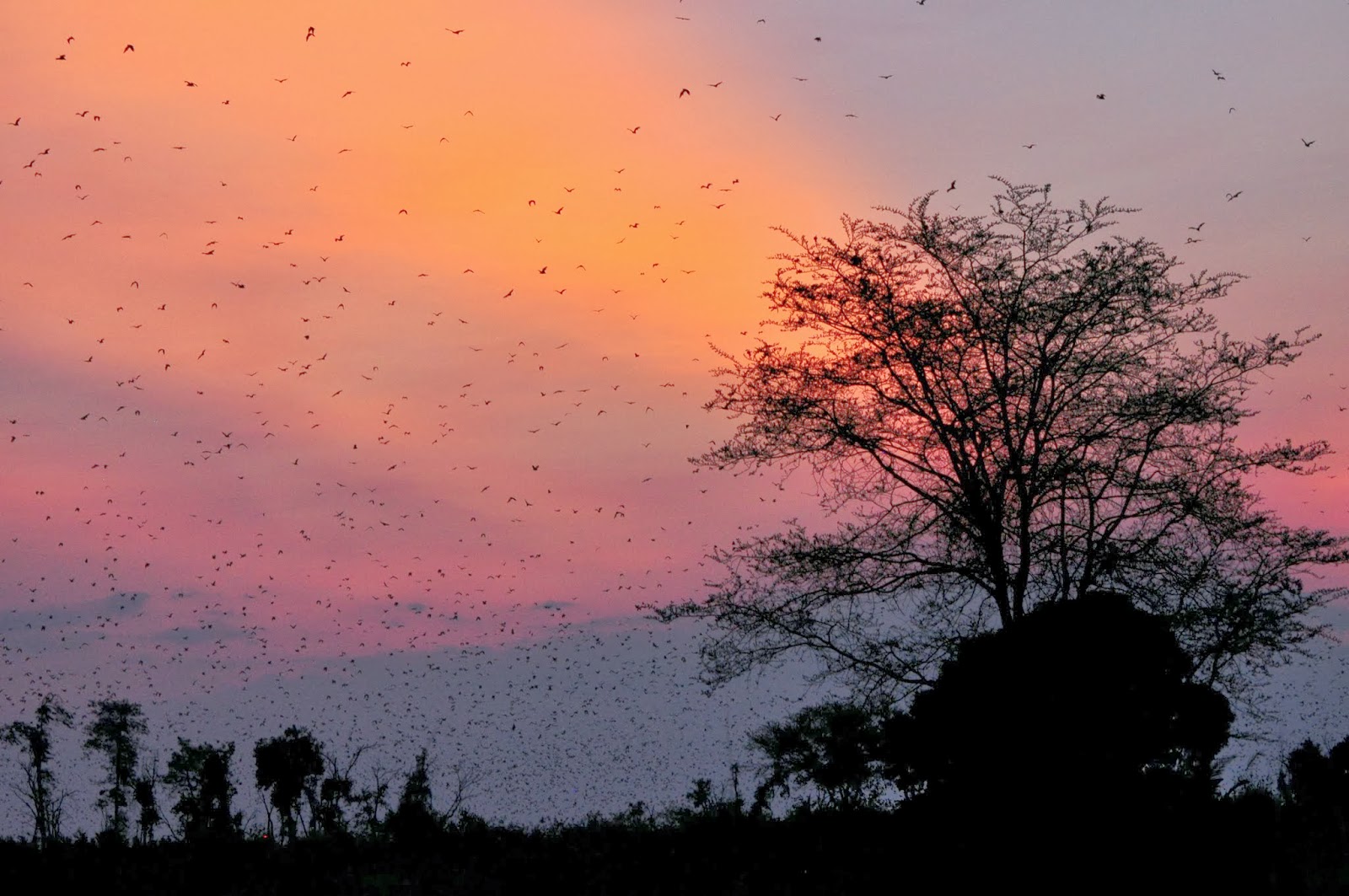
It’s that time of the year again; the other weekend we packed ourselves into the Rav’s and went north for the bat migration. As usual it was a great trip, and because the bats had shifted their roosting place closer to the viewing area, we were able to witness it from what felt like a whole new perspective. This year BBC came to Zambia to film the migration for the BBC Africa series. It’s featured in Episode 2 of the series, “Savannah”. I think a quick cameo from us dedicated bat watchers would have added something nice, but it seems they’re not interested in filming humans for this program. This year we also included a stop over at a nearby waterfall. It was really a stunning place; it felt like we’d walked down into some preserved prehistoric oasis. Swimming at its base after hiking in the heat was an excellent way to close out the trip.


Re-reading this post, I realized the content is, in many ways, very similar to the post I had written this time last year (am I becoming that predictable?). If I had just waited until next Thursday I would’ve included a bit about the Thanksgiving dinner that we’re planning to have. I think it’s safe to say that, like every year, it’ll be a welcome and comforting reminder of home. Wishing you all a very happy early Thanksgiving. And a happy early 60th birthday to my Dad; it seems this, my 60th post, was well timed to celebrate

28 May, 2013

Moonbows and More

This last week I had the pleasure of hosting Jamie, my predecessor in the Princeton in Africa fellowship and the person that introduced me to all things Zambia. After almost two years away he came back for his first visit; what I image was a whirlwind of catching up with friends and the KF students. It was especially cool, and a bit strange, to spend time together with both him and the current fellow Jill. While we’ve shared so many of the same experiences we’ve managed to cultivate our own pretty different perspectives of our time in Zambia.

(3 Generations of PiAf Lusaka)

During Jamie's visit, we had the chance to celebrate the impending parenthood of one of our good friends Chileshe. Our friends Cecile, Claire and Jill put together a very nice, very pink baby shower which mainly consisted of lots of oohing and aahing over tiny clothing. We managed to justify our presence at this decidedly feminine event during baby charades, which was good otherwise they may not have shared their delicious nutella cupcakes with us.

(Chileshe's Baby Shower)

This past weekend we took a short overnight trip to Livingstone. Livingstone is 500 km from Lusaka, that’s 12 hours of driving in two day; not exactly around the corner. Yet, I would easily do it again to see what we did. In the months after the rainy season, when the Zambezi is at its fullest, the spray from the falls reaches high above the gorge. It is onto this dense spray that a full moon will project a ghostly rainbow stretching across the falls. It was the promise of this vision that lured the ten of us out on our brief journey south.

The elements aligned in our favor. A cloudless night, a brilliant moon, a wind that kept the spray contained within the gorge. What’s more, we found all the other tourists gathered on one viewing platform, leaving the best views essentially empty for us to enjoy. The sight was incredibly striking. Seeing the falls in the moonlight felt like a secretive and special experience, more intimate than visiting during the day. From the dark trees we quietly gazed on the flowing water while in the foreground the prominent “moonbow” stretched to the limits of the mist. We moved slowly through the park, taking in each view with the sort of reverence that something so surreal and beautiful inspires. 


(I swear these were taken at night. The long exposure is what gives the water that cool smoky effect)

18 April, 2013

Sailing Kariba

I find that April is a month that’s equally great in the US or Zambia. In Boston, it’s the true start of spring; in Zambia it’s the ideal balance of hot and cold, wet and dry. This April started off even better than usual thank to a lead in from the Easter long weekend. We traveled down to Lake Kariba, one of the closest vacation spots to Lusaka, and crossed onto the Zimbabwe side. From there we drove to the Cutty Sark Hotel, which we reached after only a few wrong turns, where we found our lodging for the weekend; four catamarans waiting for us on shore. After transferring all the coolers, food and bags from the car, and listening to a conspicuously brief sailing tutorial from our guides, we were handed sole command of our ships and turned loose on the lake.


We spent the first few hours finding our sea legs and getting a feel for the boats. By the time we had our tacking and jibing down and were comfortably cruising we realized we were pretty far from the other three boats. To our concern, two of the boats appeared to be motoring together off into the distance. Concluding that we must’ve missed a planning session, we quickly set a course in their direction and kicked our motor into high gear. Looking over our shoulders we clucked in dismay as the last boat shrank to a white dot in the distance. We tried texting and calling, in vain, to get them to start their motor and hurry after us.

The sun went down before us, a very beautiful splash of color silhouetting the island ahead and setting fire to the water around us. It was around this time that the last boat finally got through to our phones. Their motor had broken while trying to “rescue” a shipmate that had been thrown overboard. They had been drifting listlessly, without power or wind, for the last few hours that we had been motoring away. In their retelling of the story, they would claim they thought it was the end and had made their peace with God, which explains why they’d gone through almost their entire liquor allocation for the weekend. The three working boats consolidated ourselves onto two and sent one of the guides back for the stranded catamaran while we went to make camp at the island. As it was already getting dark by this point, we weren’t too hopeful about seeing our friends anytime soon.

(Photo credit: Jonny P)

Once we hit sand at the edge of the island we tied the remaining two boats together and started preparing dinner. The stars were coming out in force and before long almost everything above us was alight; the Milky Way a stroke of white paint across the sky, so bright its reflection shimmered in the black water. Then came moonrise. Like a great ego it lifted from behind the Zimbabwean hills, heavy and red; nearly full. It outshone everything else in the sky, its presence adding even more to the romanticism of our evening. In much less time than we were expecting we saw the twinkling of flashlights and heard the shouts from the two approaching boats, one towing the other. Reunited, they regaled us with their ordeal over dinner, after which we fell asleep one by one on mats and blankets lain on the decks of the boats under huge mosquito nets hung from the masts, the wind blowing through the rigging.


I woke up to sunrise peeking through the tall grass on the island, waving in the morning breeze. For a moment I thought I was on Cape Cod, but the grunting of a nearby pod of hippos quickly brought me back. We spent the day on the water. When there was wind we sailed, when there wasn’t, we drifted, played cards, jumped in the water (when we were far from shore), and generally lounged around the boat. We sailed past wildlife; elephants grazing on shore, hippos basking in the shallows. At intervals we brought the boats together but we spent the majority of the time on our own. One of my favorite parts of the day was navigating the boat under wind power through an area of petrified trees jutting out of the water. We went fishing as the sun was setting, and some of the catches were big enough to be featured on the menu that night. We ate together at one long table; a fire behind us, the water before us and the stars above us.


We got an early start the next morning, Easter Sunday, as our destination was a long way off and we needed to take advantage of the wind. That morning we had the best sailing of the weekend, really picking up speed and covering some ground before the wind died down around lunch. We stopped off at a nearby island then met up with the other boats on the other side for the final leg back to the hotel. Hanging off the boat as we pulled close to our cove I realized how stress-free and happy I was. It was a restoring few days of good food, good company and a beautiful environment.  I think most of us would agree that this was one of the nicest, easiest and most relaxing weekend trips we’d ever been on.

22 March, 2013

Mutinondo (Or, a Pit Crew in Training)

March is the month of long weekends in Zambia. Taking time to recognize everything from youth, women and the resurrection of a certain carpenter requires significant leave from work. Zambia is a large, spread out country and going anywhere outside Lusaka is usually a hike. These long weekends offer a perfect chance to visit those destinations which are typically just out of reach.

Our destination of choice this time was Mutinondo, a park situated in the north not too far from where the bat migration takes place. In the early morning hours we crammed ourselves and all our gear into two trusty RAV 4s and set off on the 7 hour journey. Back home, driving 7 hours south would take me to four states, through at least six significant metropolitan centers, and past countless rest stops and restaurants. Here, there’s only one that matters: Fig Tree CafĂ©. Sometimes I think it’s the only reason I go out of town. It’s a bright point in an early morning drive, coming at the exact moment when you start to come down from that initial start-of-vacation high.

Not long after our morning communion with baked goods and coffee we were forced to pull over. The leading car had a flat, but between the two cars we scrounged together all the necessary equipment and got to work with surprising efficiency. In no time we had it changed and were back on track; no sweat. In the next town we’d repair the flat and keep ourselves covered. However, once there we learned the flat was unfixable, and, it being a holiday, there wasn’t anywhere to buy a new tire. Then we learned the spare on the other car was also unusable. The best we could do would be to put a tube in the flat, which we did, in case the worst happened, which it did. 

A few hours later the spare loudly and messily gave up the ghost. Its death throes of flying rubber shredded the mud flap to bits and shore off part of the bumper. We limped into a rural church and, under the watchful eye of some Witnesses (now I know why they're not called Helpers) we, for the third time that day, removed the bike rack, took off the spare (punctured but filled with a tube) jacked the car up and replaced the tire. By that time we all had our assigned roles in the process and were actually getting quite fast about it. After the car was back together we congratulated ourselves then set off at a much more cautious pace, negotiating the last 20 km of dirt road as gingerly as possible.


All this stress and excitement made us that much more appreciative of the magnificent wilderness we were entering. A fault runs below the area through which magma has bubbled up creating clusters of rounded, purple black hills surrounded by flat terrain. Rivers cut through the volcanic rock resulting in a number of strikingly beautiful waterfalls. A minimum of dangerous land and water wildlife means these hills are prime for exploration. Over the course of the weekend we hiked, biked and swam our way across the reserve; jumping off waterfalls, scrambling over mountains and bushwhacking through the trees. While it makes me shudder a bit now, it was a good thing for the enjoyment level at the time that we learned about black mamba encounters (and chases) in that area after we’d come back.

It was good to take time away from the city, surrounded by trees and water and stars. It’s always good to get away from exhaust and congestion for a while, to eat campfire meals and be in the sun and spend entire days at a time outdoors. It’s also good to be away from home if only because you appreciate it more when you come back. For example, I’m glad to be near other people, and not hundreds of km from anyone, when the unexpected happens. We had yet another flat tire on the way back, but this time we were without any working spare. Very luckily for us, we had just reached a town where we found a second-hand tire that, while not quite the right size, was able to fit on the car (though not before it took us an hour to figure out how to the flat off the car). It was also good to be in a bed again. Some heavy rain at night, and the fact that I’d accidentally brought a damaged tent, led to a couple restless nights of sleeping in the car. Still, let it be said that not one of these setbacks detracted from the experience. It’s hard to feel anything but good in a place like that.

30 November, 2011

Bats and a Bird

Thanksgiving has always been one of my favorite holidays. It conjures up memories of fallen leaves, chilled crisp air, family catching up around a table, a delicious home-cooked meal, and nursing food comas around a smoldering fire.

How do you celebrate Thanksgiving in Africa? You search, borrow and improvise. Turns out, it’s a pretty exportable holiday.

Our families may be far away, but good friends make their own sort of family. My roommates and I did our best to create an authentic setting. We pulled together all the table and table-like objects in our home (including the washing machine) and covered them in fabric. We set proper place settings and lit candles and even projected a fireplace on the wall. The weather did its part to recreate home, gifting us with a damp, chilly day.


My roommates and I found a turkey and the makings for stuffing. This was my first turkey, so I was fairly concerned throughout the whole process. But, with help from my roommate, it came out golden brown and delicious.


Our guests brought everything together with their outstanding cooking. The scrumptious spread included:

-          The Turkey
-          Roasted Rosemary Chicken


-          Cheesy Bread


-          Corn Casserole
-          Green Beans
-          Mashed Potatoes
-          Gravy


-          Sweet Potatoes with Marshmallows and Candied Pecans


-          and of course, Apple Pie


(Sitting down to dinner)

The next morning, we roused ourselves early (not without a struggle) to head north to Kasanka National Park. Every year tons (hundreds of thousands? millions?) of fruit bats migrate from all over South-central Africa to this particular park. My friend explained the attraction well: “Bats are like hair; if you see one you might be like ‘ew’ but if you see a whole bunch, you think ‘wow, that’s pretty beautiful.’”


We offroaded to our campsite, pitched our tents, and then set out to catch the bats taking off at sunset. I’m not sure anything could have prepared us for what we saw; it is such an extraordinary event. It started suddenly; someone spotted a few bats overhead, and they quickly grew in number. We rushed from a parking lot to an open field to get a better view. We could see a bat cloud swirling and growing in size amongst the trees in front of us. It grew and grew and eventually headed our way, spreading across the sky as far as the eye could see. It was hard to capture the scale of it on camera, but the setting sun behind the clouds did make for a nice backdrop.


The next morning, we awoke early to see them returning to their trees at sunrise. On the way, some of us rode in the bed of the pickup. The bumpy half hour ride was made completely worth it by our surroundings. To watch the light grow imperceptibly; to see the trees and animals materialize out of the heavy mist, to catch sight of the first bats flying overhead through the tree canopy, following the car; it was all incredible. Watching the sun rise over misty fields from the hide built into a tree high off the ground was wonderful as well.


The most beautiful moment of this very beautiful weekend, in my opinion, came on our drive back to camp after the sun had set. After fording a river, we came out into an open field. Switching the car off, we could see thousands of fireflies all around us. As we sat in the darkness, more and more of them materialized. The stars pushed their way through the clouds and, on the horizon, thunderheads crackled with lightening. It was one of those moments that will stick with me for a very long time.

25 October, 2011

We Survived Rapid Five

When we rolled out of Lusaka on Friday en route to Livingstone, I wasn’t sure what to expect from the next three days. What followed was one of the most adventurous and fun weekends I’ve had in a long time. I hope my summaries together with the pictures will do justice to our experiences.

Arriving at our hostel Friday night, we briefly explored Livingstone’s main drag before calling it an early night. In the morning I was able to meet up with Erin, the only other Princeton in Africa Fellow in Zambia, for a delicious breakfast. It was really nice to see firsthand where she lives and works and hear more about what her fellowship experience has been like. While we reside in the same country, our lives definitely differ in a lot of ways. I’m envious of her proximity to nature, Victoria Falls and all the outdoor activites around.

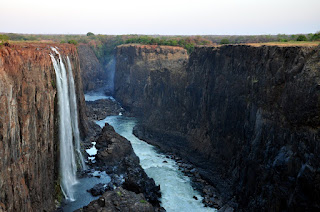
After breakfast, I caught up with our group which had grown as people continued to arrive from Lusaka by bus. We set off for the falls toting our cameras, bathing suits and plenty of sunblock. We stopped off at the bridge connecting Zimbabwe and Zambia, where two of our friends zip-lined across the canyon, before arriving at the main park. Losing all track of time, and probably giving myself mild heat exhaustion, I wandered up and down the path facing the falls with my camera and tripod looking for good shots. As it is the height of dry season, the flow of the falls is a mere trickle compared to the last time I’d seen it in 2008. The water was less impressive, but it allowed us the chance to really get a look at the enormous gorge and the towering walls. 


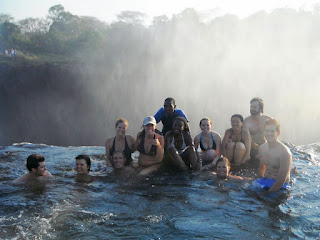
I made it back to the group just in time for our afternoon tour along the edge of the falls. 11 of us and our guide picked our way across what is typically the rushing Zambezi River, but is currently a mostly dried up rocky riverbed. We traced a path literally right along the edge of the gorge towards the ominously named Devil’s Pool. Fearlessly, we forded the remnants of the river and picked our way over stones worn smooth by flowing water. Finally, we reached our destination; a pool of water directly on the edge of the cliff. 

(The group ahead of us in Devil's Pool)

The pool is formed by a uniquely shaped rock which marks the edge of the cliff and encloses some of the water from the current. On both sides, the river still rushes past and tumbles down the canyon wall. From a rocky island we jumped into this fairly small pool. We were instructed to carefully jump far enough to avoid the rocks at the near edge, but not so far as to leap over the 300 ft drop directly behind. Being in Devil’s Pool stands out as one of the most simultaneously exhilarating and terrifying moments of my life. Two feet to my left and I would have joined the rushing flow plunging to the base of the falls. Instead, we were treated to an up close perspective of the raw power of the falls and enjoyed a beautiful sunset from atop one of the wonders of the world.

The following day we white water rafted down the Zambezi. In a convoy of large yellow rafts we put into the river below the Zim/Zam bridge, just after where the falls come crashing down. Rafting the Zambezi is best in the dry season, and we came at a time when the river is at just the right height and the rapids are at their finest. Never having been rafting before, I wasn’t sure what to expect. It became apparent to me from the very first rapid how absurd this experience was going to be. We basically paddled as fast as we could into each rapid, then threw ourselves at its mercy. In the bigger rapids, there were huge drops followed by giant walls of whitewater that would smash across the raft, sweeping away anything, or anyone, that wasn’t properly secured. 


On Rapid 5, known as the Stairway to Heaven (or, the Highway to Hell), we experienced our flipping fiasco. I can really only describe what transpired based on the video footage we watched at the end of the trip; everything in the moment was just water and whiteness. We crashed hard into the first wall of water in the rapid and our raft flipped easily, flinging two of us away and trapping two underneath. 


We continued through the rest of the rapid in these less than ideal locations. Those under the boat fought their way out and clung on. The other “long swimmer” and I were eventually picked up by safety guides in kayaks who had followed us in. For those 15 to 30 seconds in between, though, the experience was pretty harrowing. Getting to the surface was a struggle, but even then it was difficult to catch any breath as I got hammered again and again by white walls of water. All the while I’m trying to remember how to position my body to avoid getting my feet caught in rocks or slamming into them head-on. Needless to say, I was very happy when the kayaker fought his way close enough for me to grab hold. Clambering back into the raft at the end of the rapid, out of breath and shaken, we looked around at each other with wide eyes. The Zambezi had shown us who was boss, and we continued onward with that lesson in our minds. 

Minus the temporary loss of one of our shipmates to Rapid 7, we passed through the remaining rapids without any more serious incidents. In total we traveled 27 winding kilometers through 24 rapids. They ranged in size from small enough for us to intentionally swim through to one that was so dangerous we were forced to walk around it. In between rapids we admired the towering canyon walls, did a little swimming and conducted a few inter-raft raids. Exhausted, sunburned and soaked to the core at the end of the day, we were nonetheless happy and triumphant. Despite the occasional near-drowning experience, I wouldn't hesitate to go rafting again.


Monday was a holiday (Independence Day) so we didn’t have to hurry back to Lusaka. We woke up early Monday morning, had another delicious breakfast, then drove over to the Mosi o Tunya game reserve to do a short self-drive. Even in the morning the sun was strong and the heat seemed to push most of the animals into the shade and out of sight. We were lucky enough to locate one of the park guards who led us on foot to see the rhinos. The only seven white rhinos in all of Zambia are located in this park and are guarded 24/7 to protect them from poachers. We got close enough to see one of the mothers and her calf and take a few photographs before beating a hasty retreat back to the car. Having been charged a few times, our guide was happy to play it safe. Still, it was incredible to see these enormous tanks of animals in their natural habitat. Satisfied with this as a proper ending to our trip, we hit the road and made it back to Lusaka in good time. I've already started planning my next trip to Livingstone.


01 August, 2011

Homemade Pasta and Hugo the Hippo

The one month mark has come and gone. The fact that it slipped by unnoticed is a good sign; between a full work load and an eventful after work scene life has been pretty busy, but it’s been time well spent. Today is a new marker in my life here, one that’s a bit more noticeable. This will be the first night I spend away from my host family and in my new home. If you’re looking at a map of Lusaka, I’ve moved from way down in the bottom right corner up to the center-middle to an area called Kalundu. I’ll be living in a four bedroom house with two Zambians guys and an Australian girl. Having been able to spend time with them since arriving in June I know they are all great, hard-working people who are also a lot of fun. I actually got to know the two guys more while working as a photographer at a concert their production company, R&G Events, put on last weekend. I’m really looking forward to spending at least the next six months at this house. Most of all I’m excited to put down some roots, to finally unpack my suitcases, and to start cooking in my own kitchen.

(Working at the concert)

Before moving out of the Mwenye household, I cooked them a farewell dinner. I decided to go with an old standby; my interpretation of my Dad’s interpretation of my Grandmother’s unbelievable pasta sauce. I picked up fresh tomatoes, onion, garlic and parsley from the farmer’s market and was able to find most of the other ingredients at the grocery store. With some help from Aunt Paulina and Gertrude we managed to cook a pretty authentic version of the dish which was eyed warily at first as it bubbled in the pot, but was eventually enjoyed thoroughly by all.

(Gertrude enjoying her pasta)

This long weekend (today was Farmer’s Day) also contained another exciting event. It was my first time since getting here that I left the boundaries of Lusaka. A casual suggestion on Saturday morning came together quickly, and impressively, into a full blown overnight trip to Lake Kariba in the southeast of the country on the border with Zimbabwe. It’s hard to explain the full benefit of escaping from the dry crowded city into the rolling green hills and being close to a body of water for the first time in this land-locked country. While the road required some attentive driving, between overloaded trucks and sporadic potholes, the ride was only about two and a half hours and the scenery was captivating. The lake itself was massive; at 5,580 square kilometers it is the largest artificial lake in the world. It is the product of a dam that filled in a massive river valley along the Zambezi and which now supplies power to both Zambia and Zimbabwe. Unfortunately we were unable to swim due to the triple threat of bacteria, Nile crocodiles and the ever dangerous hippopotamus which call the lake home. We did, however, take a beautiful sunset cruise at night, and in the morning were able to go fishing. While as a team we failed to catch anything larger than my thumb, we did come very close to a troop of island baboons, and our guide managed to snag himself a tiger fish, which lives up to its namesake in the tooth department I must say.

(Sunset over Lake Kariba)

While the trip was on a whole extremely relaxing, we did find ourselves in a uniquely stressful situation after our sunset cruise. As we pulled up to shore we suddenly realized we had a rather large visitor in our campsite. Grazing his way toward our tents was the 5,000 lb resident of the area, Hugo the Hippo. It was very cool to see one outside of water and to really get a sense of their sheer mass; it’s much bigger than a cow and probably as tall as a horse. On the other hand, this bulk combined with their high aggression and territorial nature makes them one of the most dangerous animals in Africa. So it was with some trepidation that we approached to within thirty feet of Hugo to make our campfire and cook dinner. Having to walk past him to the bathroom sent my heart racing- every time he would raise his massive head from grazing and fix me with that unnerving stare it was all I could do not to sprint for the nearest building. We all breathed a little easier once he wandered off into the night, but I wasn’t the only one who later dreamed in his flimsy canvas tent of that massive beast meandering back through our site. Ultimately we survived our hippo encounter, and I came back to Lusaka today refreshed and ready for an important and busy week at work where we begin to narrow down this year’s applicant pool for the scholarships.