12 March, 2016

Equatorial Thrills

What does Bungoma, Kenya have in common with Quito, Ecuador and Singapore? They sit on the same latitude, roughly between 0 and 1 degrees in the Northern Hemisphere.

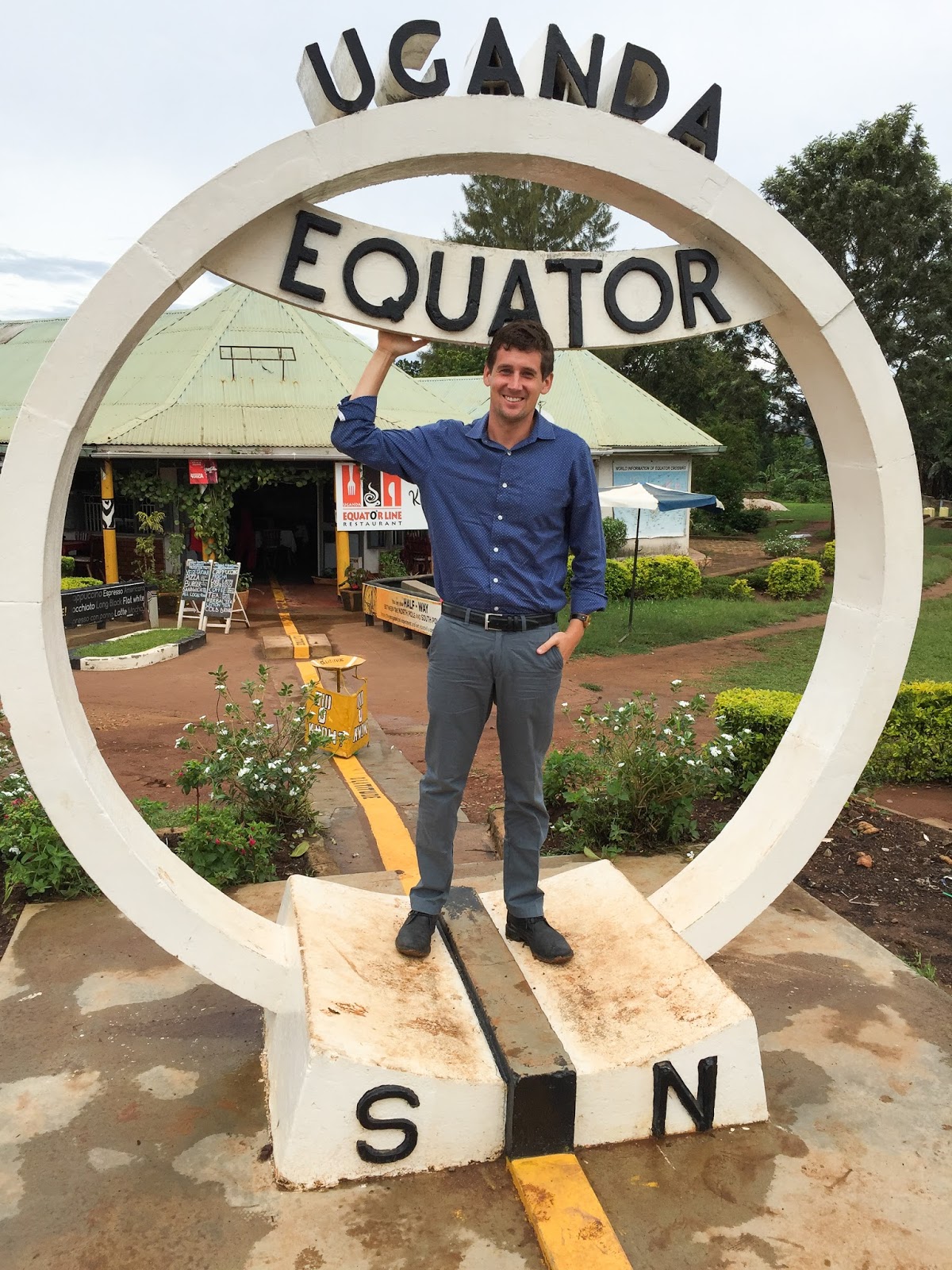
What’s life on the equator like? (and I mean almost literally on the equator- I leave my house in the northern hemisphere to fly out of the airport in the southern hemisphere).

Well there’s no sign of the big red stripe that’s so eye-catching on desk globes, but there are some harder to see anomalies going on. The rotation of water is a particularly cool one. You might know that water spins counterclockwise in the Northern Hemisphere and clockwise in the Southern (the Coriolis Effect), but this idea has always been sort of intangible to me. At the equator crossing in Western Uganda, they have a little roadside exhibit which makes it much more real.

Let me set the scene: there are 3 yellow basins with holes at the bottom, one each to the north and south, and one directly on the equator. They’re each about 5 feet apart. Together you start in the north. The guide pours a bucket of water into the basin, and then delicately places a recently plucked flower in the center. As the water drains, the flower sits on top spinning counterclockwise. Then he walks you a few feet across the equator and repeats this in the basin there. This time, the same flower whirls in the opposite direction. Finally, when he places the flower in the center of the 3rd basin right on the line, it doesn’t move an inch. It sits perfectly placid until the water drains and it falls through the hole.


In hindsight, it seems obvious that I should’ve taken videos, but I was so enthralled with this little terrestrial miracle that I didn’t think of it. Equatorial thrills! Next post will include a decidedly more celestial equatorial phenomenon, which we contemplated heavily while staying in a rooftop room at a beautiful beach house on the Kenyan coast last week.

29 February, 2016

Hozier: NPR Tiny Desk Concert

Hozier's been on the radio for years, so I realize I'm a little late to this party, but it was only recently that I heard his full self-titled album after listening to this Tiny Desk Concert, and I was really impressed by both. It's one of those rare albums you can listen to all the way through, which I've been doing repeatedly since late last year. His talent and vocal range are especially striking watching him live.

24 January, 2016

Interesting Things in Your Ear

When I started as a supervisor of loan officers at FINCA in Zambia, I bought a car. My commute on the bus had become untenable after I moved to a new branch, and with a car I could take a more direct route. It didn’t save me from traffic entirely though; my commute still pushed an hour each day. After playing my music collection to the brink of fatigue, I needed a new way to pass the time. That’s how I came into podcasts, and I've been listening to them ever since. I figured it was worth writing down all my favorites in one place. I’ve listed them all first, and added my thoughts afterwards.

Short (15 - 30 min)
Planet Money - economics
99% Invisible - design
Song Exploder - music

Long (30 min - 1 hr)
Radiolab - science
Car Talk - cars and humor
This American Life - peoples' stories
Serial - investigative reporting
Open Source - current affairs

Video
NPR's Tiny Desk Concerts - music

Planet Money- clever and funny podcast highlighting interesting stories that embody some economic themes. Entertaining, short, and lots of them available for download.

Radiolab- new or interesting things related to science, philosophy, humanity, etc. Almost always fascinating, sometimes unbelievable.

This American Life- stories told by people, often interesting, typically emotional or thought provoking. Can be indulgent or boring at times, but frequently very good.

Car Talk- ostensibly about cars, but the focus is more on the hosts and their interaction with people calling in. The humor is classic, but nothing fancy. Also objectively a good way to learn about cars.

More recently, I’ve found some new favorites, and I keep realizing how much is actually out there:

99% Invisible- exploring design and the role it plays in our lives, often in overlooked places.

Song Exploder- artists walk you through the thinking that went into developing one of their songs. Always gives me a deeper interest and appreciation for the song afterwards.

Serial- a spinoff of This American Life, it features investigative journalism into murky criminal cases. The new season is a lot different than the first one, but they’re both good in their own ways.

Open Source- a friend turned me onto this one recently. It’s a news show about current events, featuring great guests and an intelligent host.

NPR’s Tiny Desk Concerts- not the best phone downloads since they’re videos, but feature tons of great artists looking cramped and awkward (and human!) playing shows behind a desk.

05 December, 2015

Frequent Flyer

The first year of living outside the US felt like a long time, but each passing year has felt progressively shorter. No surprise there, that’s how life works. Sometimes, though, you get a flash of perspective that makes you realize how the time has passed. This recently happened when my good friend Sarah executed on a trip to Kenya that we’d been talking about for a long time. Sarah also visited me in Zambia, 3 years ago, which is hard to believe. 

Cruising the Zambezi, June 2012

We only saw each other once or twice in the intervening time, so it really felt like it had been a while. It was wonderful to have her back again, albeit it in a very different location. It was also great to meet her good friend Josie; they’d been traveling the world since finishing law school, and Kenya was their last stop together.

Just like last time, her visit was the impetus for a multi-day vacation to see more of the country I live in. They came all the way out to Bungoma, which is a hike from Nairobi. I’m really happy they did, because they were able to see my home and daily environs, hang out with Emily, meet some friends, and see a bit of One Acre Fund’s work.

Before Bungoma, we spent a night at Rondo Retreat in the Kakamega rain forest, a nice place to relax after their long flight and do some catching up. After our time in Western province, we embarked on an ambitious car ride down to the Maasai Mara- the Kenyan side of the famous Serengeti park in Tanzania. We stayed at Sentinel Camp, an eco-camp with no permanent structures, only tents. “Tents” is a misleading description though, because safari tents are huge and quite comfortable. The owners were nice enough to extend resident rates to all three of us, so it felt like a great deal. 

We only stayed two nights, but in the Mara that’s apparently all you need to see an overwhelming assortment of animals. In the first drive alone we saw multiple sets of cheetahs, and on our second afternoon we were incredibly lucky to see one of the few remaining groups of wildebeest cross the river as part of the end of their great migration to Tanzania. It was surreal: this was one of the first images of Africa I was ever exposed to as a kid, and it felt pretty special to witness it in-person.

Sarah and Josie were both wonderful guests and traveling companions, and it was sad to see them go so soon. I don’t know where I’ll be in another 3 years, but wherever it is I hope I’ll have recently had the pleasure of another Bartle visit. At this point, though, it’s probably my turn to come to her…


04 November, 2015

Ode to Nescafé

    Oh powdery substitute
    When we meet I tremble
    From overdose
    Caffeine or sugar, I'm never sure
    Keep your ideal ratio guarded
    Like a state secret, impossible to determine
    Better with milk, but best with powdered milk,
    strangely. Kindred spirits maybe
    But I always find you
    Wherever I am
    Unpretentious
    Accessible
    A loyal chicory comrade


10 October, 2015

Tea Years

A few weekends ago, Emily and I celebrated our three year anniversary. Hopefully the bad title pun will make sense in a minute. It blew my mind more than a little bit to think about how three years have passed already, and how full of adventures they've been. 

We went to the Nairobi to celebrate, where by lucky chance Emily's previous company was holding a retreat the same weekend. We were able to see many old friends and colleagues from Zambia, people we knew at the beginning and throughout the first years of our relationship.

It was great catching up with all of them. We relived old times with Jeremy, Alison and Kevin losing at blackjack, had brunch together, spent some time with Esther, Paul and Abby, and went to a "friends of IDinsight" happy hour where we met the rest of the growing team. We spent a good 24 hours straight with all of them before they went off to their work retreat. It's hard saying bye, but we're also very lucky to have seen them so often since leaving Zambia.

(Hanging with Abby)

On the morning of our anniversary we drove to Kiambethu Tea Farm, where a British immigrant first grew, made and sold tea at the turn of the century. We listened to an instructive talk from his granddaughter, who now owns the farm, and learned some new tea facts. For instance, I had no idea black, green and white tea all come from the same leaf of the same plant, and the difference depends on how they're processed. She had excellently brewed tea for us to try, and served us a hearty and colorful farm lunch in the afternoon. 


(Colobus monkey joining us for lunch)

(Tea talk in the tea field)

In the evening, Emily took me out to a delicious dinner at Talisman enjoyed with a nice wine courtesy of my parents (thanks guys!) Even though we were almost stranded by our taxi, it was a great meal and a great end to both the day and weekend.

20 September, 2015

The Windy City that Wasn't, and Other Coastal Travels

There’s so much of Kenya I haven’t seen, and I’ve been here almost a year already. Most of my time has been spent in Western Province around Bungoma, and in Nairobi. These two areas are what I think of when I think of Kenya, even though that couldn’t be further from reality.

I felt this plainly when I recently visited the coastal region of Kenya for a work trip. My colleague and I were observing the programs of a tree-planting company that offers smallholder farmers a way to generate more revenue from unused land. The land situation was clearly very different than the generally fertile Western Province where One Acre Fund works. A drier, more unpredictable climate and sandier soil means people aren’t able to grow many crops consistently. Thus, hardy varieties of trees can present a unique, if long-term, value proposition.

While visiting and learning from this particular company, we stayed at one of the few accommodations in the small town of Kilifi, which happened to be a backpackers. It gave our work trip a nice relaxed feel, and since it was right on Kilifi Creek we were able to start our days with a refreshing morning dip. We also had time one night to go out to eat at a seafood restaurant right on the water. The very friendly, very ridiculous Swiss owner ordered us local oysters, smoked fish, and a whole platter of assorted seafood. It was a nice treat considering our limited fish options in Bungoma. Not a bad place to be based for the employees of the company we were visiting.

 (Walk from the office to our lodging)

(Mahogany tree nursery)

(Creek-side seafood)

Kilifi wouldn’t be the only time I visited the ocean in the last month either. At the end of August I traveled for the first time to Maputo, Mozambique. I was there to speak at a conference for financial regulators, from the perspective of rural financial inclusion. I also arranged to visit another MFI while there, up in the center of the country. But in between, I would have a weekend to spend in the city.

I booked an Airbnb as it was by far the most affordable option, and it was really a great deal. The people I stayed with were super friendly (even if they didn’t speak English that well), and their apartment was beautiful, with a balcony overlooking the water. It was also walking distance from a lot of key places, including the conference site.

I arrived in Maputo to grey skies, below 60 temperatures, and a strong wind from the sea that whipped the 8th floor apartment violently every night. It was chilly and blustery for my first few days, even though my hosts assured me it was never ever like this and would change by tomorrow, then the next day, then the next day…

It didn’t matter too much as I was there to work anyway, and the conference was indoors. The event went well, I met some interesting people, and even as I confront the video evidence of me speaking I still feel it went ok. The Saturday following the event I braved the cold at a waterfront café for a few hours before retreating back to the apartment, but not before checking out the very small, very old Museu de História Natural on my way back. It was 50% closed, and 90% of what was open consisted of dead stuffed animals, looking pretty worse for wear. What really struck me was the staged violence of so many of the exhibits; I guess drama and gore are great ways to generate interest in your humble museum.


(The natural world is a violent place)

Luckily, on my last day in Maputo the weather cleared and I enjoyed a day exploring the town. Maputo reminded me a lot of Dakar, both cities on the water, both a little bit crumbling, and the only two places I’ve been where non-British countries were the colonizers, and the difference is really palpable. Of course the language is the most obvious distinction; most people I met spoke little to no English, and I speak little to no Portuguese, so I got a lot of mileage out my ten words of Spanish. The difference goes deeper than language, though, and it’s hard to describe, but not having those familiar British undertones in a the place makes you feel doubly foreign.

I enjoyed Maputo a lot though, despite the wind and cold. It feels very safe and walk-able and there seems to be lots to do in the way of food, music, and activities. During my day on the town I enjoyed some clams beachside, then watched 20 people pull in a huge fishing net from the adjoining beach. After that, I went into the seafood market where there are stalls and stalls with the widest and most colorful variety of seafood I’ve ever seen. There were prawns and clams of all sizes, blue crabs, huge gaping fish, and rock lobsters the size of my arm that looked like they’d been painted. I selected a single tiger prawn, which was whisked away and grilled behind the scenes while I waited. Sea to stall to table- all within sight of each other.


(My tiger prawn)


Though I only had one nice day in Maputo, and my second stop in Mozambique, Chimoio, was not nearly as pretty, I got a good feeling from the country and hope to be able to return and explore more someday soon. The one highlight from Chimoio: the existence of selfie-sticks in this tiny town.