30 June, 2016

The Adams Do East Africa

When my family visited me in Zambia over the 2012 holidays, it felt like a once in a lifetime experience. Seeing lions on Christmas Day? Spending New Years at Victoria Falls? It was such a unique and special trip for all of us. So I was pretty surprised and excited when, just a couple years later, it looked like they'd be able to come to Kenya too.

Having moved to a new region opened up the possibility of an entirely different kind of trip. Sure, Kenya is famous for its game parks and wildlife, but it also has the coast (!) and proximity to lots of other amazing places. We settled on a cross-country itinerary, that’d bring us to the beach, the rainforest, and into the maize fields of western Kenya.

Stop 1: Nairobi- no rest for the weary

When my family showed up in Nairobi, we immediately took them out on the town.  It was actually lucky they got delayed overnight in Doha, giving them at least a little time to rest. We started with the only repeat activity from Zambia: visiting an elephant orphanage. At the David Sheldrick orphanage you can get up close and personal with the elephants, and even pat them if you’re lucky. We then took animal intimacy to the next level at the Giraffe Center, where the giraffes will stick there heads inside a raised platform to collect treats (even right out of your mouth!).


Stop 2: Zanzibar- sun in the rainy season

Zanzibar, a classic East African destination, is one I’d never actually been to. My unfamiliarity showed itself from the start, with me unknowingly booking us a week there in the heart of the rainy season. No wonder all those hotels and restaurants were closed! Plans were locked in by the time I realized my error, so we went ahead, with the price discounts as a small silver lining.

In the end we got lucky and hit a stretch of beautiful weather just after they’d had a few weeks of heavy rain. Because it was the off-season we were some of the only tourists around. 

We spent our first two days on the island in Stone Town, the old section of the capital Zanzibar City. The age of this ancient city, inhabited for 500+ years, is reflected in its convoluted yet organic layout. Narrow streets, with turns every 100 feet, snake between tilting old buildings laden with shutters, porches and roof decks. Small shops and eateries spill out onto the roads, down which horse carts and scooters alternatively plod and zip. It’s a place full of history and great food, beautiful rooftop sunsets and the muezzin calls of many mosques. There’s an open-door neighborly culture, but also a hectic pace of life on the street. And it’s hot, really hot.

In addition to exploring the city, we also went for a ‘spice tour’, where we got to see how about a dozen different spices grow, including nutmeg, vanilla, cardamom and cloves. Spices used to be a major export for Zanzibar, but now a big money maker is setting up these small family owned farms growing a diverse array of spices to host tourists like us. And boy did we look like tourists by the time they were done with us!


From this clamoring seaside city we transitioned into the quieter interior and on to the eastern coast of the island. On the way, we stopped off in Jozani Forest and got up close to a family of red colubus monkeys. 


Hotel Matlai is on the southeast coast, near Pingwe, and it exceeded all our expectations. Walking in the house, we were overwhelmed with the view out the open side facing the ocean. A long pool (complete with floating pillows) stretched out from under the roof to the beach, and the low tide colors made it look like a painted scene. Because it was low season, we had the house to ourselves, and we made good use of all its lounging and reading spots. We were right on the beach, and when the tide was low we could walk far out, though the high tide hid the rocks and sea urchins and made swimming less appealing.


We went out for a few excursions on the water: once, to go snorkeling in the reef and admire the beds of giant, colorful starfish, and the next time with a fisherman to hunt octopi on the sandbar. The two we (he) caught were grilled up by the hotel for a delicious lunch. We ended our time in Zanzibar with a sail around Chwaka Bay on a traditional dhow.


(Photo cred: Sophie)

Stop 3: Kisumu- birthday city

Zanzibar and Bungoma are not close, so we decided to break up the journey with a few stops along the way. We spent our first night back in Kenya in Kisumu, where our nearest airport is located. I had a nice early birthday dinner by the lake with everyone on a beautiful evening.

Stop 4: Kakamega rainforest- featuring birds and fireside Uno games

The next day we parted ways with Emily, who returned to Bungoma ahead of us while we spent a couple nights in the rainforest at Rondo Retreat. My family enjoyed the homey feel of the place, made all the more cozy by intermittent chill and drizzle. We went for a few walks in the forest, on which we saw tons of birds and learned a thing or two about birdcalls from our expert guide. I also got to see my sister really doubt my judgment when we were surrounded by monkey calls in the pre-dawn forest darkness on our sunrise hike.

(Sunrise over the forest)


Stop 5: Bungoma- home base

The trip ended at our house in Bungoma, where we were lucky enough to be able to house everyone within our own compound. It was fun to have my family as neighbors for a couple days, and also to show them where we live and work (it’s not always easy to find the line!) Our awesome hosting staff took them on field visits to our warehouse and research center, and they had a fun Kenyan/Indian fusion dinner one night with Emily’s team. Like their visit to Zambia, it was great to be able to share many of the faces and places that make up daily life, to make everything that much more concrete and relatable.

(Squished in a tuk tuk)

In fact, the trip didn’t even end there. Although we said goodbye to Molly and my parents, Sophie stuck around Bungoma for another 2.5 weeks to do her end of high school internship. Emily linked her with a school where she occasionally helps out, and Sophie was able to set up a short term project. I was impressed with her vision to make it happen, as well as her ability to be on her own and carve out her role at the school. We also had some time to do fun things on the weekend like tubing on the Nile in Jinja, hiking in Bungoma, and exploring downtown Nairobi. Seems like she had a good time, and we really enjoyed having her (and the rest of them!) around.

(Excited about cool art projects!)

(Making friends with one of the kids living at the school)

22 May, 2016

The Trek to Wagagai

The last time I spent longer than a day hiking anything, I was probably smaller than the backpack I was carrying. It would therefore not be unreasonable to see committing to hiking the second tallest mountain in Kenya over four days as highly optimistic.

To be precise, though Mount Elgon straddles the Kenya – Uganda border, its highest peak is located entirely in our neighbor to the west. This made it an ideal meeting place for our Easter weekend get together. Friends in Zambia who used to live in Uganda were eager to come for a visit, and another friend from Lusaka had recently moved to northern Uganda, while Emily, our colleague and I were easily able to hop over from Bungoma. That’s how we came to gather at the ominously named but enormously helpful Rose’s Last Chance outside of Mbale, Uganda one late March evening.

Rose, of Last Chance fame, helped us organize porters and guides for our trek ahead of time, so we were in pretty good shape to leave the next morning once we managed to cram all our supplies and cooking gear into our packs. It was still early morning by the time we were taking our first steps through villages and farms, heading towards the border of the national park.

To get the same feel of that first day, you could drag a stairmaster out into the summer sunshine. Once we entered the park, things got vertical fast. Eventually though, we entered the rain forest-esque zone and the pitch of the ground flattened out some.

As we hiked up we passed through more zones; surprisingly varied ecosystems stacked on top of one another. The higher we got, the more the trees thinned out. The scrub was replaced by tall brown grass, fields of it, dotted with prehistoric trees shaped like old multi-light street lamps. Once we were up in the foothills of the mountain, these vistas rolled along to either side of us, just high enough to keep the peaks out of sight.

We camped the first night at significant elevation and prepared for a summit ascent in the early morning. “Summit ascent” carried a certain weight in my mind, conjuring an image of ice axes, crampons and oxygen tanks, but of course it was nothing like that. We started behind schedule, as we did every morning, so consistently in fact that our guide started to work it into our wake up calls. By the time we left the loose cover of the small grove where we’d camped, the sun was stretching white rays across the brown grass. We were bundled up even then, as the light didn’t chase away the chill, but we’d come to learn how strong it could be at altitude.

By this time we could see the first, slightly shorter peak that we would eventually skirt around. The climb was gradual, with only a few short steep pitches, while the altitude was the real challenge. Our steps took more attention, and it was amazingly easily to become winded. We were careful to avoid overexertion and altitude sickness, and I certainly didn’t mind lots of little breaks.

At mid day we crested the ridge leading to Wagagai Peak, and it was only an hour or so until we summited. The exact height of Wagagai is a satisfying 4,321 meters (14,000 ft) above sea level, but the view wasn’t the precipitous drop I had imaged. Instead, stretched around us were the rolling foothills we had just navigated. Through a pass in the distance we could make out a village our guide told us was in Kenya. Weary and accomplished, we sought out worn patches of rock or little bits of grass to rest on. Enjoyable as that respite was, the sun really worked us over, and I got some of the worst burns I’ve ever had. I suppose the ridiculous outfits I had to sport afterwards for extra protection, including gloves, were the silver lining for all of us.

We spent that night in the same campsite after descending from the summit, and readied ourselves for the distance we’d need to cover the next day to reach the other side of the mountain. It really was a trek: 33km over rolling hills, climbing out of a gorge only to descend back into the next one, then the next one, and so on. The views were stunning when we were on hilltops and able to look down the long valleys. Crossing the caldera, the site where this ancient volcano essentially imploded, we were ringed by tall chimneys and jagged crests of red rugged rock protruding from the earth.

Most of us were feeling very weary when we finally stopped for lunch, not halfway to our next campsite. The rest of the day was a blur of sun, sweat and heavy breathing, but we finally allowed ourselves some optimism upon entering the thickening brush signaling the end of the plateau and the start of our descent.

Not too long after, running from a gathering storm that thankfully never reached us, we were standing at the mouth of a massive cave, Tutum Cave, with a stream of water falling front and center. It was here under this water, with the waning light and the high chattering of the bats roosting within, that we washed off days of dirt and sweat and cleaned the wounds and blisters we now boasted. The campsite, though muddy to reach and infested with ants, was inviting in the knowledge that it would be our last.

The following morning, squeezing bandaged feet into sodden shoes, we started our final descent. The trees changed from bamboo forests to thick vines and trunks, and the downhills became steeper and more direct. And suddenly, the birdcalls were playing harmonies with chainsaws and we could look down and see a town, and the edge of the park. At the gate we managed to haul ourselves onto motorcycle taxis, which carried us at relatively astonishing speed down the dusty roads to deposit us at a crumbling guesthouse near Sipi Falls. We sat and admired one of these stunning falls, beer in hand, feet released from their prisons, before treating ourselves to a real shower, a nice meal, and a bed.

I've heard people refer to Type II fun, something you don’t necessarily enjoy at all times throughout but look back on in a positive light. I think this would qualify; certainly I can’t remember the last time I pushed myself that hard. But there’s a real sense of accomplishment in traversing an entire mountain, especially when you think back on how far you’ve come. Cliché as it sounds, this particular hike pushed me to enjoy the journey, since the whole thing was a journey really, and to appreciate the subtle changing beauty of our surroundings. Even with more realistic expectations, I’d still set out on a trek like this again. Or maybe that’s the Type II fun talking…

(We traveled from Budadiri, bottom right, up to Wagagai Peak, down to Tutum Cave, then exited through Forest Exploration Center)

 (The upper ecosystem, first peak visible in the distance)

(Circumventing the first peak)

(Post summit nap)

(Valleys stretching from the caldera)

(In the caldera. Photo by Jeff)

(Help with sun protection. Not pictured, my gloves. Photo by Jeff)

(Colorful little guy we ran into)

30 April, 2016

Preview: The Adams Do East Africa

In the last 11 years I've probably celebrated 2 birthdays with my family. Falling in the spring, it often coincided with college vacations, and then I moved abroad. They always manage to do something nice for me though, whether it's cake over skype or care packages full of goodies and party decorations. This year they did one better: they were with me in Kenya! It was part of a larger exciting trip which I'll share more about, but I felt very lucky to be able to celebrate with my whole family and Emily that day. A few pictures from the visit:

(Giraffe Centre, Nairobi)

(On the beach in Zanzibar)

(Back of a tuk tuk)

(Rooftop in Stone Town)

12 March, 2016

Equatorial Thrills

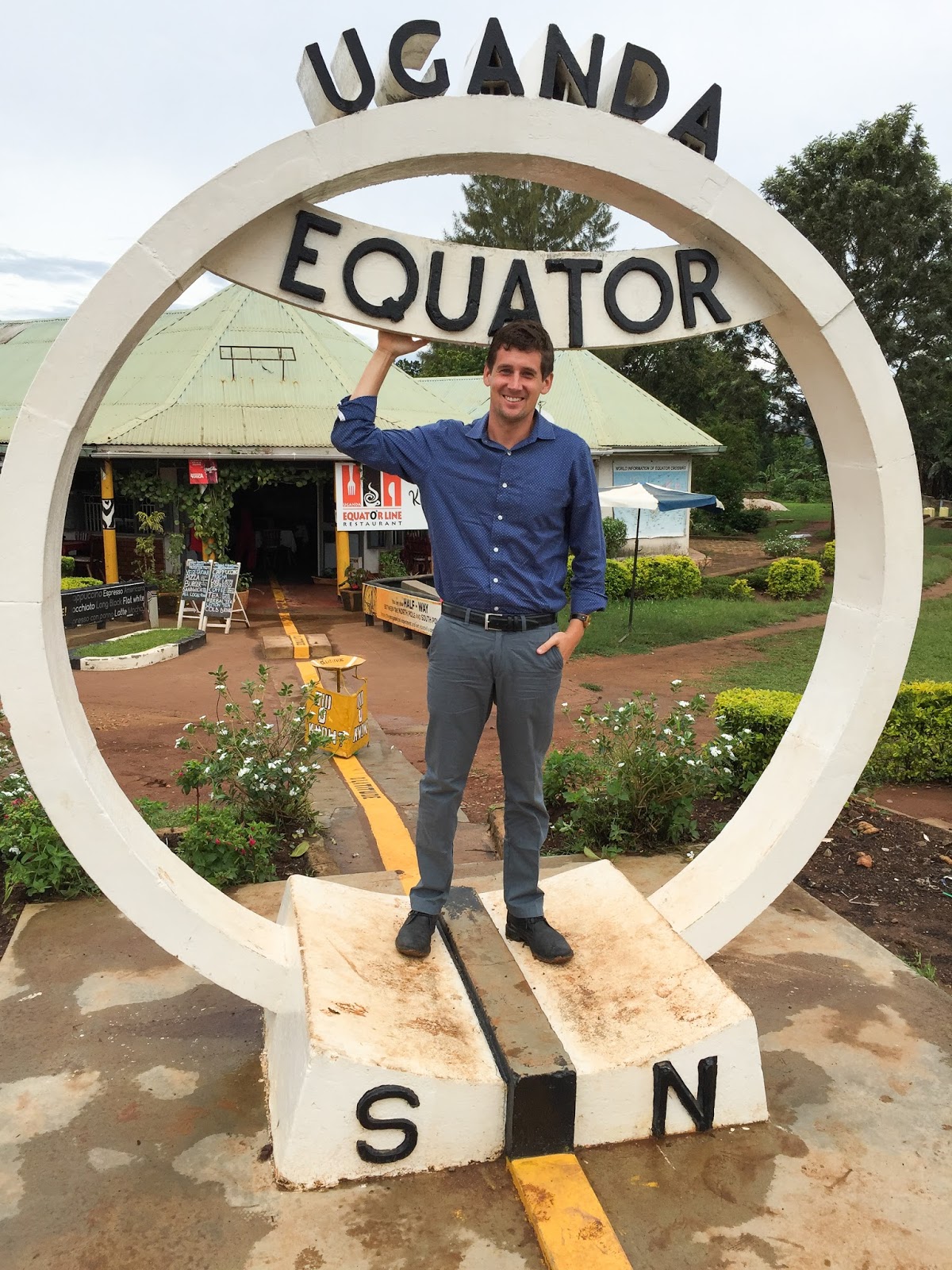
What does Bungoma, Kenya have in common with Quito, Ecuador and Singapore? They sit on the same latitude, roughly between 0 and 1 degrees in the Northern Hemisphere.

What’s life on the equator like? (and I mean almost literally on the equator- I leave my house in the northern hemisphere to fly out of the airport in the southern hemisphere).

Well there’s no sign of the big red stripe that’s so eye-catching on desk globes, but there are some harder to see anomalies going on. The rotation of water is a particularly cool one. You might know that water spins counterclockwise in the Northern Hemisphere and clockwise in the Southern (the Coriolis Effect), but this idea has always been sort of intangible to me. At the equator crossing in Western Uganda, they have a little roadside exhibit which makes it much more real.

Let me set the scene: there are 3 yellow basins with holes at the bottom, one each to the north and south, and one directly on the equator. They’re each about 5 feet apart. Together you start in the north. The guide pours a bucket of water into the basin, and then delicately places a recently plucked flower in the center. As the water drains, the flower sits on top spinning counterclockwise. Then he walks you a few feet across the equator and repeats this in the basin there. This time, the same flower whirls in the opposite direction. Finally, when he places the flower in the center of the 3rd basin right on the line, it doesn’t move an inch. It sits perfectly placid until the water drains and it falls through the hole.


In hindsight, it seems obvious that I should’ve taken videos, but I was so enthralled with this little terrestrial miracle that I didn’t think of it. Equatorial thrills! Next post will include a decidedly more celestial equatorial phenomenon, which we contemplated heavily while staying in a rooftop room at a beautiful beach house on the Kenyan coast last week.

29 February, 2016

Hozier: NPR Tiny Desk Concert

Hozier's been on the radio for years, so I realize I'm a little late to this party, but it was only recently that I heard his full self-titled album after listening to this Tiny Desk Concert, and I was really impressed by both. It's one of those rare albums you can listen to all the way through, which I've been doing repeatedly since late last year. His talent and vocal range are especially striking watching him live.

24 January, 2016

Interesting Things in Your Ear

When I started as a supervisor of loan officers at FINCA in Zambia, I bought a car. My commute on the bus had become untenable after I moved to a new branch, and with a car I could take a more direct route. It didn’t save me from traffic entirely though; my commute still pushed an hour each day. After playing my music collection to the brink of fatigue, I needed a new way to pass the time. That’s how I came into podcasts, and I've been listening to them ever since. I figured it was worth writing down all my favorites in one place. I’ve listed them all first, and added my thoughts afterwards.

Short (15 - 30 min)
Planet Money - economics
99% Invisible - design
Song Exploder - music

Long (30 min - 1 hr)
Radiolab - science
Car Talk - cars and humor
This American Life - peoples' stories
Serial - investigative reporting
Open Source - current affairs

Video
NPR's Tiny Desk Concerts - music

Planet Money- clever and funny podcast highlighting interesting stories that embody some economic themes. Entertaining, short, and lots of them available for download.

Radiolab- new or interesting things related to science, philosophy, humanity, etc. Almost always fascinating, sometimes unbelievable.

This American Life- stories told by people, often interesting, typically emotional or thought provoking. Can be indulgent or boring at times, but frequently very good.

Car Talk- ostensibly about cars, but the focus is more on the hosts and their interaction with people calling in. The humor is classic, but nothing fancy. Also objectively a good way to learn about cars.

More recently, I’ve found some new favorites, and I keep realizing how much is actually out there:

99% Invisible- exploring design and the role it plays in our lives, often in overlooked places.

Song Exploder- artists walk you through the thinking that went into developing one of their songs. Always gives me a deeper interest and appreciation for the song afterwards.

Serial- a spinoff of This American Life, it features investigative journalism into murky criminal cases. The new season is a lot different than the first one, but they’re both good in their own ways.

Open Source- a friend turned me onto this one recently. It’s a news show about current events, featuring great guests and an intelligent host.

NPR’s Tiny Desk Concerts- not the best phone downloads since they’re videos, but feature tons of great artists looking cramped and awkward (and human!) playing shows behind a desk.

05 December, 2015

Frequent Flyer

The first year of living outside the US felt like a long time, but each passing year has felt progressively shorter. No surprise there, that’s how life works. Sometimes, though, you get a flash of perspective that makes you realize how the time has passed. This recently happened when my good friend Sarah executed on a trip to Kenya that we’d been talking about for a long time. Sarah also visited me in Zambia, 3 years ago, which is hard to believe. 

Cruising the Zambezi, June 2012

We only saw each other once or twice in the intervening time, so it really felt like it had been a while. It was wonderful to have her back again, albeit it in a very different location. It was also great to meet her good friend Josie; they’d been traveling the world since finishing law school, and Kenya was their last stop together.

Just like last time, her visit was the impetus for a multi-day vacation to see more of the country I live in. They came all the way out to Bungoma, which is a hike from Nairobi. I’m really happy they did, because they were able to see my home and daily environs, hang out with Emily, meet some friends, and see a bit of One Acre Fund’s work.

Before Bungoma, we spent a night at Rondo Retreat in the Kakamega rain forest, a nice place to relax after their long flight and do some catching up. After our time in Western province, we embarked on an ambitious car ride down to the Maasai Mara- the Kenyan side of the famous Serengeti park in Tanzania. We stayed at Sentinel Camp, an eco-camp with no permanent structures, only tents. “Tents” is a misleading description though, because safari tents are huge and quite comfortable. The owners were nice enough to extend resident rates to all three of us, so it felt like a great deal. 

We only stayed two nights, but in the Mara that’s apparently all you need to see an overwhelming assortment of animals. In the first drive alone we saw multiple sets of cheetahs, and on our second afternoon we were incredibly lucky to see one of the few remaining groups of wildebeest cross the river as part of the end of their great migration to Tanzania. It was surreal: this was one of the first images of Africa I was ever exposed to as a kid, and it felt pretty special to witness it in-person.

Sarah and Josie were both wonderful guests and traveling companions, and it was sad to see them go so soon. I don’t know where I’ll be in another 3 years, but wherever it is I hope I’ll have recently had the pleasure of another Bartle visit. At this point, though, it’s probably my turn to come to her…